
Why Competing with Yourself Is a Win-Win--in Writing...and in Life
Another Running Metaphor

A Runner’s High
This past Sunday, I ran a 10K, my first 10K race since 2022. I signed up for the run at the end of March, inspired by my guiding word for 2026, immersion.
My all-time personal best 10K time was from a 2018 race, so one of the first things I did to prepare for this 10K was write down my 2018 time/pace and put it where I’d see it every time I got ready to run. I only had two months to prepare for Sunday’s 10K and hadn’t run that far for a few years, so I recognized that my 2018 time was probably a long shot, but it was still a helpful reminder of what was possible. I then set an attainable goal for myself—one that I knew I could do, but which would also challenge me.
And then I made a training plan—and stuck to it.
I wasn’t running to win the race. I was running, in large part, because I enjoy the act of running. But one of the reasons that I enjoy races is because I enjoy pushing myself; I enjoy the competition with myself—the challenge to see how well I can do, how much I can improve.
I often compare writing to running (and to drawing), but, really, any activity that requires some level of skill, dedication, and practice can lend itself well to being a useful comparison.
While running and writing may seem quite different, the method of practicing either pursuit is remarkably similar, right down to the fact that I sometimes need to force myself to go out and run or force myself to sit down and write, but as soon as I start, I’m glad I did. The surge of dopamine hits and I think, man, this is the only thing I ever want to do. (The dopamine surge is much stronger for me with writing, but even so, the rush from both activities is similar.)
Writing is hard. Running is hard. Improvement for either takes time, patience, and intentional practice.
Beware Complacency: Some Tips
I was once naively comfortable with where I stood as a writer. I believe this sense of complacency often stems from a lack of self-awareness—or perhaps being willfully (or simply innocently) unaware. For me, the big change in awareness came when I started becoming involved in a more robust—and broader—literary world. I was living in Iowa City at the time, a mecca for creative writers, and suddenly my deficits were much clearer to me, and I was, in a manner of speaking, jolted out of my complacency.
Tip 1: To help avoid getting too comfortable/too complacent, surround yourself with people whose skills surpass (or are at least equal to) yours.
After (and even before) my last 10K in 2022, I found myself running slower and slower, even though I was running with the same sporadic regularity as I always had; I had even resigned myself to believing that I’d never be able to run another half-marathon (my last one being in 2016), and maybe not even another 10K.
But then I joined a local run club. Much like what happened with my writing, the exposure to runners who were much better runners than I was motivated me. As I witnessed what others were doing, I realized that it was well within my capabilities, too, and my excitement for running was renewed.
Tip 2: Don’t sell yourself short.
I’m signed up for a half-marathon at the end of October. Yes, training may take longer at my age—and may be harder—but barring any unforeseen medical issues, there is no reason why I shouldn’t be able to do it. And no reason, in fact, why I can’t aim to beat my previous best half-marathon time (from 2015). This is one reason why I signed up for last Sunday’s 10K: to create an interim goal for myself. Incentive. And to immerse myself in the process of training.
To remind myself that I can.
Tip 3: Set a goal, make a plan (and stick to it), and regularly assess your progress.
Based on the information available to me (e.g., past and more recent run times), I set a time goal for my 10K even before I started training. By the end of April, though, I saw that my initial goal was not going to be challenging enough, so I adjusted it to make it more challenging but still within my grasp.
I think that setting a challenging (but attainable) goal and having a way to assess progress is crucial.
And this is where I see a lot of writers falter. In fact, part of my own complacency as a writer 15 years ago or so stemmed from the fact that I had no good way to measure my improvement as a writer. It’s hard enough for a writer to edit their own work, let alone try to assess it for improvement. Time can sometimes help; it’s fairly easy to look back at poetry I wrote 25 years ago and see how awful it was. But sometimes I look back at work from 15 years ago and am equally surprised at how good it is. As we grow as writers, we do become better at assessing our own work, but measuring it for improvement? What do you use as your benchmark? How do you know if you’re meeting your goals?
With running, you can document your running time, distance, and pace, and easily document your progress over time.
One of the reasons that I encourage writers to submit to literary journals is because submitting to a literary journal is akin to a runner like me signing up for a race that pushes me and gives me a reason to practice and train.
Intention. Immersion.
Can I do better than I did last time? What areas do I need to work on? How do I need to modify my training to improve?
Before I was regularly submitting to literary journals, I had almost no gauge with which to measure my writing progress. But believe it or not, rejections (and acceptances, too, of course) can be a viable way to measure your writing progress.
Tip 4: Don’t underestimate the value of “sweat equity.”
The Habitat for Humanity website states that sweat equity is “about doing the work—the hard work—to bring an idea to life.” It goes on to note that sweat equity is an investment “as real as money or land.”
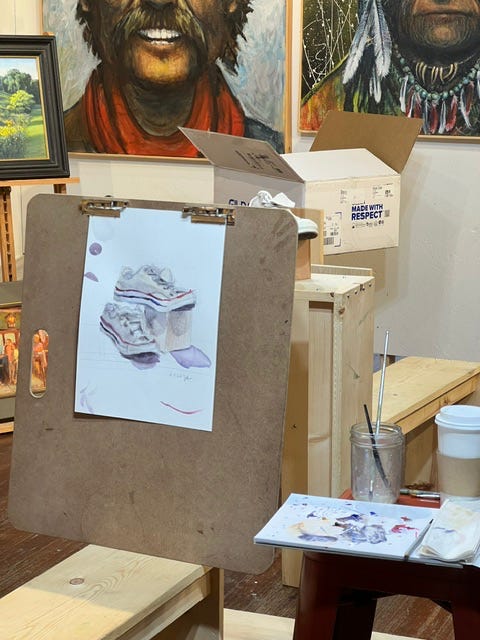
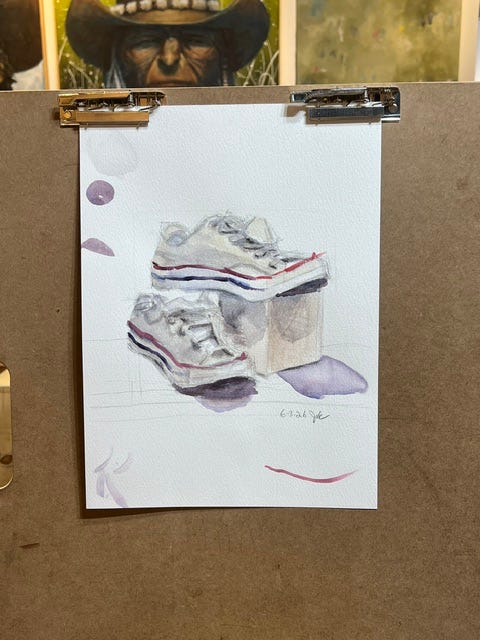
This idea of “sweat equity” came up today during my weekly art lesson. We live in a society that wants things to happen fast. That doesn’t want to wait for results. That tends to balk at change or hard work. That often blindly accepts the status quo. But accepting the status quo often hinders growth and innovation. And not putting in the work—the sweat equity—often leads to subpar results.
There’s nothing inherently wrong with being “comfortable” with where you’re at with something; for example, I’m happy to be a relatively complacent cook (😂), simply because I’m not all that interested in taking the time to get better at it and I don’t enjoy it that much. I do occasionally drift out of my cooking comfort zone, but I’m typically focused on whatever is healthy, quick, and easy, so when I find something that works well for my lifestyle, I stick with it. We certainly can’t pour sweat equity into every little thing we do.
But if your goal is to continue to improve as a writer, comfort/complacency will often be an impediment to your progress.
Win-Win
When I first started my business in 2019, I remember being impressed at how many other entrepreneurs took the time to offer me insight and support, many of whom were in the same industry (editing) as me. There was an immediate recognition that we were not in competition with each other.
I got where I am today (both as a writer and a business owner) through support and generosity from others—often people who had never even met me or barely knew me. People who believed in me, who wanted me to succeed. Other writers, other editors, and other entrepreneurs.
As runners and as writers, we are only competing with ourselves. And competing with yourself is a win-win situation.
Competing with yourself means focusing on what you can control.
Running a race is pretty much the same as submitting your work to a literary journal. There are different levels of races, some that are more competitive than others. And how well you fare will depend on a number of factors, many of which are outside of your control. What is within your control as a writer is the quality of your work and not whether it gets chosen for a journal.
One thing I loved about running the 10K on Sunday—besides it being a gorgeous day and perfect weather for a run—was how confident I felt at the beginning of the race. My first long training run in April was tough; I wondered if I could even do it. The second long run was easier. Etc, etc. By the time I got to race day, the 10K that once felt daunting now felt manageable. I knew I could do it. And it didn’t matter what anyone else did, how anyone else ran. I couldn’t control them. I could only control what I did.
And writing (and submitting) is much the same. It gets easier with practice. And then once it gets easier, you move to a higher level and do it all over again. Continuing to challenge yourself and improve.
That is what immersion is about.
Latest Publication News
My story “Imposter Syndrome” made the shortlist in Gooseberry Pie’s annual six-sentence story contest and was published on May 14. I encourage you to check out the whole special issue, which includes the winners, honorable mentions, and all the short- and long-listed stories—it’s magnificent!
I was also thrilled to have my story “The Hitchhiker” published recently in Fictive Dream—my first time publishing in that journal!
Upcoming, on June 13, as part of National Flash Fiction Day (UK), my story “Just Another Life Experience” will appear in FlashFlood!
Need Prompts? Coming in July: An Ekphrastic Prompt Extravaganza—for Paid Subscribers
In July (starting July 6), I will be offering paid subscribers a month’s worth of ekphrastic prompts.
Select prompts will be available to free subscribers as well.
Hot Flash Literary—Open for Submissions through June 12!
Just a reminder that Hot Flash Literary is still open (through June 12, 2026) for submissions for Issue 4: Instant Karma. Open to flash up to 500 words by women-identifying writers. Read full submission guidelines here.
New to JEK Writes? I’m thrilled you’re here! If you missed my previous post on patterns, repetition, and recurring characters, you can read it here. Or scroll through any of my earlier posts on the JEK Writes homepage.
Want to support JEK Writes, but not ready to become a paid subscriber? You can buy me a coffee!
Imposter Syndrome is wild! I loved it. Colin ran a marathon back in his 30s and he absolutely loved the whole experience of it. I am glad you conquered your return to the 10K!
Love that you are doing a prompt challenge next month!
I have found the same thing about the connection between the running and the writing.
Congratulations on the race!