
Back to the Drawing Board
Ways to Approach Your Writing When You're Feeling Discouraged

Art Imitating [the Writerly] Life
I occasionally like to share glimpses of my weekly art lessons, highlighting the parallels between the drawing and writing processes.
For example, in both drawing and writing (and pretty much anything in life), there are bound to be setbacks that can lead to feelings of discouragement and a loss of motivation.
About a month ago, I was thrilled with how my charcoal drawing of a pair of boots turned out. The angles, the measurements—I was ecstatic! It gave me a feeling similar to when a story comes together just right; there’s a surge of excitement, often followed by a surge of optimism and motivation. I can take on the world! It’s one of my favorite feelings and is reminiscent of the rush I’d get when performing in plays in high school. There’s a kind of clarity to the feeling. This is what I’m meant to be doing. This is me!
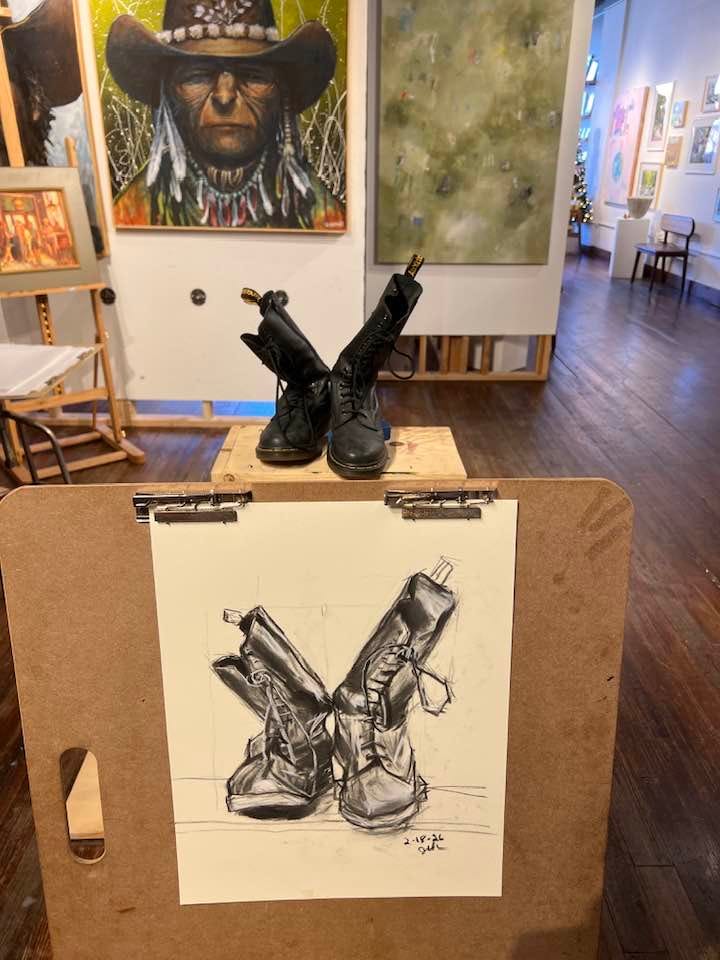
But, of course, that euphoria doesn’t last.
The week after I drew the boots, I tried drawing my running shoes. A valiant effort perhaps, but the proportions were off, as were a couple of my angles.
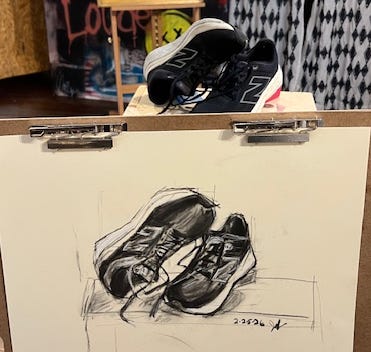
No euphoria, but I was still optimistic. This was just a minor setback, right?
The week after that, though, I tried drawing another pair of shoes, and everything was off. (No photo evidence of that debacle!) I felt quite discouraged. That attempt prompted my teacher to review some concepts with me, reminding me of things I knew but had gotten sloppy with. Back to the drawing board. (Pun intended.)
Last week, I decided to draw boots again, albeit a different pair. I approached the boots a little differently, keeping my teacher’s lessons and tips in mind. They turned out reasonably well. Not perfect, but enough to at least touch on that feeling of exhilaration again. I’m back, baby! (Said in a George Costanza voice.)
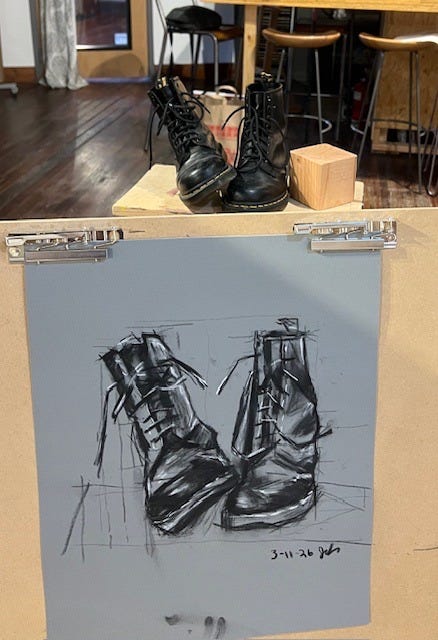
With drawing, I’m still very much a beginner, so my brain soaks up information like a sponge; I learn something every time I sit down to draw because there’s so much for me to learn. And I especially learned from my “setback.” Thankfully, my discouragement was only momentary; I got right back on the drawing horse again.
Writing is similar in that you’re not going to hit it out of the park every time, regardless of your experience level. You’re inevitably going to find yourself discouraged at times.
Such is life. And such is the writing life. (And the creative life, in general.)
It took me a surprisingly long time to internalize this, but now whenever I find myself discouraged with a piece of writing I’m working on, there’s really just one question I ask myself. One that I’d encourage you to ask yourself as well when you’re discouraged.
Does It Still Excite You?
A few weeks ago, I spent considerable time on a story that I thought had promise. Somehow, though, the more I worked on it, the less promise it seemed to have. Discouraged, I finally put the story away. The “considerable time” I’d spent was only around two or three days; the story, only about 600 words. No big deal in the scheme of things.
But what if the “considerable time” had been years? And the work, 200+ pages?
I occasionally hear writers say things like, “I’ve written this [novel/memoir/other long project] and now I wonder if it’s even any good, if it’s even worth continuing to work on.” I can often hear the frustration in their voices, see it on the page. All that time spent…
First off, whether something is “any good” and whether it’s worth continuing with are two different things. In this context, “good” likely means publishable, and most anything can eventually be publishable with enough work. What I primarily want to zero in on here is the discouragement that comes from wondering whether a project is worth continuing with, especially after having spent a lot of time on it.
And, to me, this is a fairly “easy” question to answer:
Pretty much any writing project is worth pursuing. But ONLY if it still inspires you. ONLY if it still excites you.
To me, that excitement is key. As we grow as writers—as artists—our tastes change, our lives change. A lot of stories I wrote seven or eight years ago hold no interest for me anymore. At least not in their current state. There are likely bits I can extract from them—ideas, lines, characters. Either way, nothing is lost and nothing is wasted (see Lesson 5 in this post for more discussion about that).
But even though I firmly believe that nothing, writing-wise, is ever wasted, that doesn’t acknowledge the very real discouragement a writer may feel about the work.
Ultimately, if it’s a project that you want to continue pursuing, the goal is to find a way to make it exciting again—a way to feel encouraged about it instead of discouraged.
So, how might you do that?
Tip #1: Put the story/novel/memoir away and work on something else.
A couple of years ago, I offered this writing tip, published in Cleaver Magazine: “Don’t Put All Your Eggs in One Basket: The Benefits of Multitasking as a Writer.”
This strategy of multitasking may not work for everyone, of course, and that’s okay. But I know a lot of long-form writers who also write poetry or other shorter work, and taking a break from a lengthy project to work on writing that you may be able to churn out more quickly may give you a much needed break, as well as a sense of progress.
Whenever I “put a story away,” it’s not gone forever. It’s a temporary respite. An indefinite break. I may not come back to it. But I might. And it’s almost always easier to assess my enthusiasm for the work after a break. If I’m excited to work on something again after a break, that’s a good sign. If it still feels too heavy, I let it sit some more.
Tip #2: Talk to someone—a writing peer, writing coach, etc.—about your project.
Talking about what you’re working on can be beneficial on many levels, and is actually at the crux of my Writing Coach Power Hour. When we hit a “tough spot” in our writing, we don’t always need editorial feedback; often we simply need someone to brainstorm with, bounce ideas off, or help us remember why we were writing the piece in the first place.
Talking about our project with someone who has understanding of the writing/creative process can also get us motivated and excited about it again. It’s normal for motivation and excitement to wax and wane; just like the moon, our writing goes through phases.
Tip #3: Look for stand-alone chapters/sections of your longer work to focus on and submit.
Are there parts of your longer project that you particularly like, that you keep getting drawn back to over and over again? If so, consider focusing on these chapters/sections, independent of the work as a whole, and start submitting these stand-alone chapters/sections to literary journals. If something can’t stand perfectly on its own, you might have to add some contextual details, but sometimes there is less context needed than you might think.
In my own experience, extracting a couple of chapters from a longer manuscript—especially one that still needs a lot of work—can be highly motivating, as it serves as visible progress (a “finished” piece submitted to a journal), creating incentive and bringing fresh energy to the work as a whole. As an added bonus, the feedback you might get (either from journal editors or journal readers) could give you an idea of how the longer work might be received.
Tip #4: Radical revision with prompts.
I love radical revision and employ it often. I love the way it breathes new life into a work. And if I’m stuck, I like to use prompts to help me.
People often think of prompts in terms of getting started/generating new work. But I also employ prompts when I’m stuck in the revision process. Prompts can give me ideas for going in directions that I wouldn’t have otherwise thought to go in. Meg Pokrass’s Prompts of Resilience Substack is a great resource if you’re looking for prompts to help get you out of a rut.
I also like to ask questions of what I’m working on: What if [something unexpected] would happen in this paragraph? When one element changes, this typically changes the whole piece and can take it in a whole different—and sometimes very welcome—direction.
The key to radical revision is that you have to be willing to change the story you’re working on. This can admittedly be harder for works that are close to your heart or that you have a specific intention for. But what if—what if??—you let go of that specific intention? (Note that sometimes this is easier after time away from the piece—refer to Tip #1.)
You’ve Got This!
Although any creative endeavor—be it drawing, writing, or something else—can be a lot of tedious work, I believe it should also be fun—something that brings you some kind of joy or fulfillment. Feeling occasionally discouraged/depleted at times is part of it, but it shouldn’t be a predominant part of it. So look inside yourself—and listen to yourself, how you’re feeling—and then proceed in a way that aligns with you.
Upcoming Live Webinar: May 14, 2026
Submitting to Literary Journals: Strategies for Writers
I’m excited to be teaching another webinar through the Editorial Freelancers Association (EFA)—this time on submitting to literary journals!
The 90-minute webinar takes place on May 14, 2026, at 5 p.m. Eastern Time. Cost: $60 for guests, $48 for EFA members. Early bird discount: Register before March 27 and get 10% off!
Click here to learn more/register (link goes to the EFA website). My previous EFA webinars are available as recordings; learn more on my website.
I like this post. I generally work on shorter pieces. I can see that by varying the different aspects of writing, ie : 100 words, incremental 10 line , story stacks, etc, I can overcome that defeated feeling.
Thank you for these good ideas on how to approach our writing when we get discouraged. Due to many difficult life circumstances at this point in time, I have set aside my creative writing on my novel and other short stories and am only focusing on journaling and keeping up with my blog. There have been times I feel like just chucking it all, but I love to write, especially the creative things, so for now, just to keep up the practice I am doing what needs to be done. Hopefully, I will get back to more creative pieces if and when life settles down a bit.