
Repetition, Recognition, and Recurring Characters
The Lure of Patterns

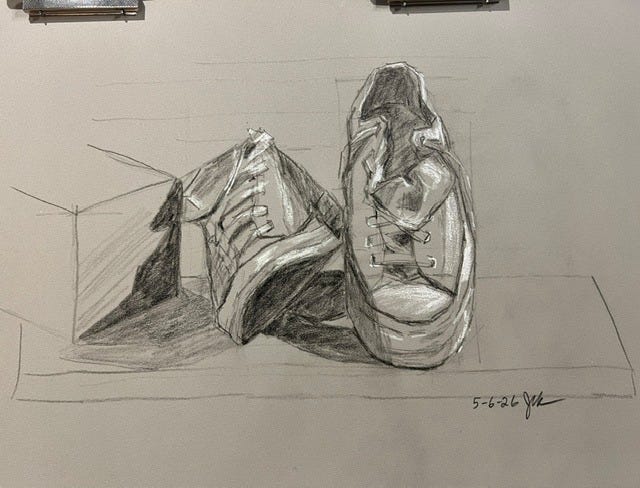
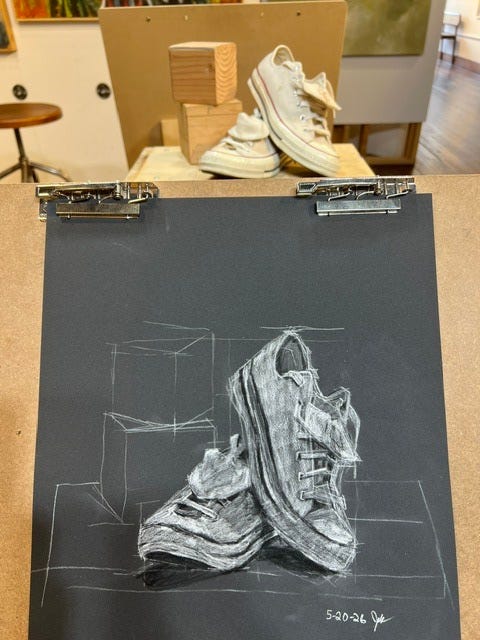
I’ve been noticing a lot lately. As in: looking with intent. Last September I wrote about looking for shapes to hone my drawing skills. But it’s not just about shapes; it’s also about patterns.
I recall a brief period of time when I was about 11 that I wanted to learn to sew my own clothes. Not because I was interested in sewing (I wasn’t), but because I was interested in clothing styles and could visualize what I wanted to wear, but I couldn’t find anything in the stores to match the idea in my mind. So I thought, hey, maybe I’ll be a fashion designer! But in the same way that I was actively discouraged from becoming a creative writer (or an actress—another of my short-lived dreams!), my fashion-designer dreams were quickly dashed, too, because, even for a preteen to think such thoughts wasn’t practical. (From a young age, I learned to hate the phrase “It’s not practical” because of how often I heard it in response to any idea I had.) My mom, who had sewn many of her own clothes as a teenager and into early adulthood, eventually relented and begrudgingly said she would help me sew an outfit, but she was insistent that I use a pattern. And I definitely didn’t want to.
A pattern in this context was stifling to me. Rigid. Rules that I had to follow. I recall my mom and I going to a store like Jo-Ann Fabrics and trying to find a pattern for this outfit idea I had in my head. My mom vetoed any pattern I liked, saying it was too hard. Ultimately, there was simply no pattern in the store that matched the idea in my head, so 11-year-old me lost interest in learning how to sew.
As a child, I thought I wanted to break patterns—eschew them—but what I really wanted was to create new, more exciting ones!
Patterns Are Not Rules
Patterns are everywhere—social constructs, architecture, nature, etc. Humans are generally pretty good pattern detectors; patterns help us solve problems and navigate our way, both literally and figuratively.
Patterns help us make sense of the world, but they are not rules.
Much in the same way that true writing craft is not rule-based. The craft of writing is based on patterns, and patterns are only limiting if you allow them to be.
Creative specialist Jeffrey Baumgartner writes, “Creativity is actually about seeing beyond conventional patterns and recognising new patterns [emphasis added].” I read this and immediately thought of Picasso and the way he was able to see beyond conventional patterns to help found Cubism. New patterns.
This idea of “new patterns” is what, in part, draws me to flash fiction.
Flash Fiction: A Genre of Space and Absence
When I try to explain flash fiction to people who are not familiar with it, I usually emphasize that it’s not word count alone that makes something flash (which is what people often think). What is most enticing to me (and my hungry imagination) is that flash is often more about what is not on the page, i.e., space and absence.
And it’s that absence that makes flash such a challenging genre.
Because that absence relies on pattern recognition (closely linked to critical/creative thinking). It often requires looking past conventional patterns.
In a lot of flash fiction, writers break conventional patterns, relying on readers to be able to make certain inferences. And in order for readers to make certain inferences, they (as well as the writer) need to (subconsciously at least) recognize a pattern.
It’s this pattern recognition that allows flash writers to understand what information to leave out, what to leave in. How to structure a piece.
And it’s not an easy task.
A powerful (and oft-shared) example of a stunning flash that makes superb use of patterns is Kathy Fish’s “Collective Nouns for Humans in the Wild.”
Repetition and Recurring Characters
When I first opened Substack to write this article, I had planned to write about recurring characters, but I soon realized that I didn’t know what to say about the topic. So, I did what I often encourage writers to do when they’re doing a close read of a piece or revising their own work: I asked why. I “interrogated” myself. Why? Why are you drawn to recurring characters? What do you really want to talk about and why?
And I realized it came down to this idea of patterns and new patterns. The seemingly contradictory mixture of familiarity/recognition and newness.
My interest in recurring characters started before I even had any stories published. I became enamored with a character I call Chaz. (My Chaz stories led to “spin-off” recurring characters, Celia and Ellee, who have appeared in several of my published stories, the first of which was “Walking on the Furniture,” published in Cleaver Magazine in 2022.)
Although I’ve been writing Chaz stories for over ten years, only one of my Chaz stories has been published so far: “Odd Mammal Out,” in The Woolf in 2023. Though it doesn’t draw on much of anything else I had written about Chaz up to that point, it was a breakthrough story for me because it was the point in which I realized that Chaz was actually a shape shifter! This opened up a whole new world of possibilities to me. Newness, even with a character I’d written a number of stories about—a character I thought I knew! Subverting expectation is a fun aspect of patterns. It doesn’t mean you’ve broken the pattern or abandoned a pattern. It just means you’ve gone deeper and found a new pattern.
And one new pattern can lead to another new pattern. And so on.
Discovery. Excitement. Innovation.
The heart of creativity.
(And, by the way, a second Chaz story, “The Hitchhiker,” will be published in Fictive Dream on May 31! I hope you’ll check it out!)
Upcoming
Look for my next Substack article, “Another Running Metaphor: Why Competing with Yourself Is a Win-Win,”* to hit your inbox within the next couple of weeks. (*Title subject to change.)
Ekphrastic Prompt Extravaganza—for Paid Subscribers!
If you enjoyed my ekphrastic prompts in April, you’re in luck, as I will be offering paid subscribers a month’s worth of ekphrastic prompts in July. Starting July 6, each Monday for four weeks, paid subscribers will receive access to an extravaganza (or ekstravaganza?) of ekphrastic prompts to use throughout July (or, really, any time)!
Hot Flash Literary—Currently Open for Submissions!
Just a reminder that Hot Flash Literary is still open (through June 12, 2026) for submissions for Issue 4: Instant Karma. Open to flash up to 500 words by women-identifying writers. Read full submission guidelines here.
My writing friend Eric has a recurring character that all of us adore! I am not sure he has ever shared his work outside writing group and that is a tragedy! Recurring characters in flash would be a blast! 💥