
Let's Talk about Shoes
Three Sometimes-Underestimated Components of Writing Creatively

First, Curiosity
A couple of months ago while on a walk, I found a blank piece of notebook paper lying on the sidewalk. It had ragged edges, had clearly been torn out of a spiral-bound book. I was immediately curious, imagining what kind of maelstrom had caused that sheet of paper to find apparent solace on a not-heavily-traversed sidewalk. In fact, I was so intrigued by—so curious about—the sheet of paper that I wrote a story about it (still in early draft form).
A couple of weeks or so later, I saw an orange sitting in the entrance of a parking lot.
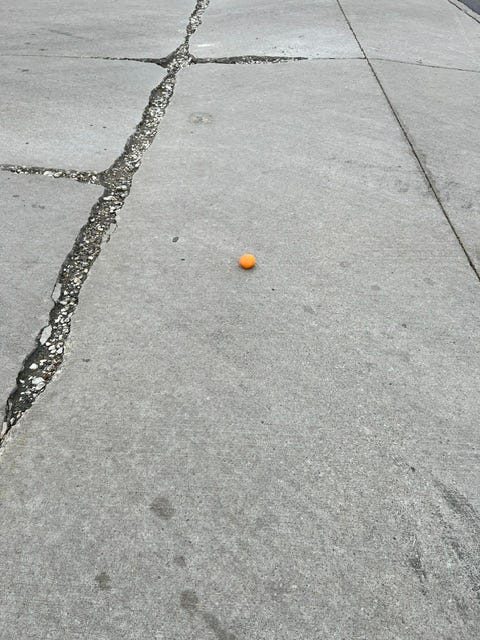
Again, I was curious. Although I didn’t write anything down, my mind was actively considering different scenarios, both realistic and speculative.
A Story of Shoes
Then, a few weeks ago, while on another walk, I saw a pair of shoes hanging on a power line. I noticed their shadow first.
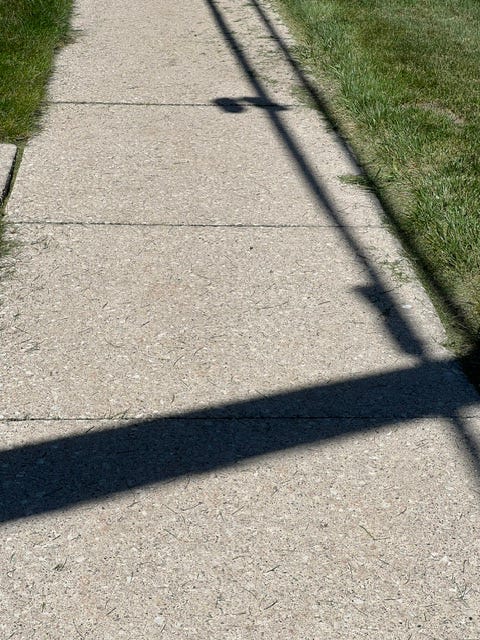
The shadow led me to look up.
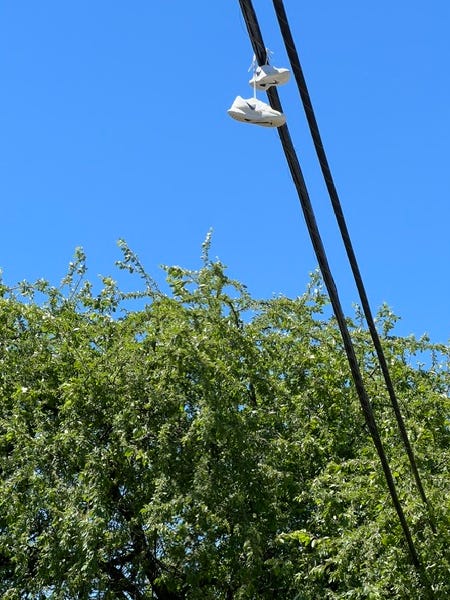
A few days later, the shoes were still there.
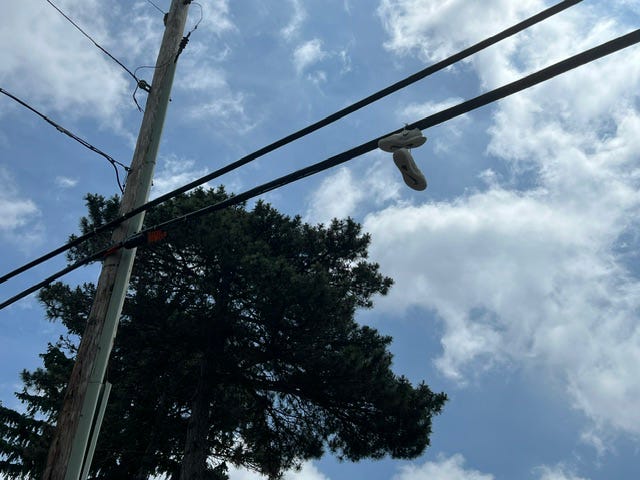
And again on June 12.
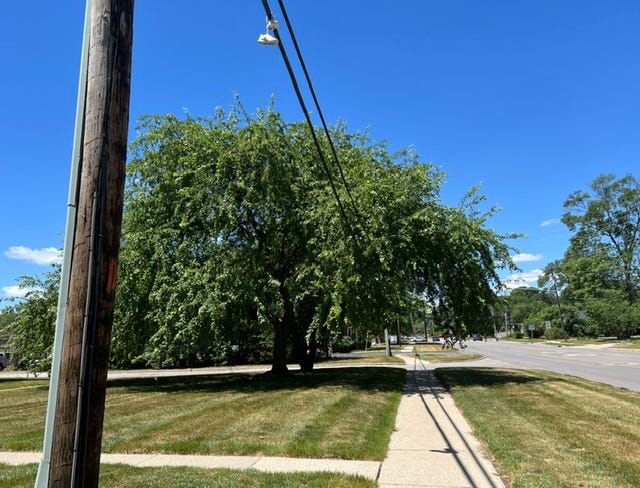
In fact, the last time I walked by (earlier today), the shoes were still there.
Something like a pair of shoes in an unexpected location naturally invites questions. Even more so than the orange in the road or the blank paper on the sidewalk.
The reason I say that curiosity (which seems somewhat synonymous with creativity in the realm of writing) sometimes gets overlooked or underestimated as a component of writing creatively is because we, as humans, sometimes get too “busy” to be curious, blindly accepting instead of questioning.
I would argue that questioning is a large part of creative writing. In fact, when I’m revising my work, I often use the word interrogation to describe parts of my process: I interrogate my word choice, my phrasing, the sentence structure, the form, the events of a story.
When you start to question, you often find endless possibilities. There is no one right way to write or revise a story. There is no one right way for a story to be.
Every time I walk past the shoes hanging on the power line, I consider different answers for why, how, and what if. I wonder how long they’ll remain there, and if they disappear, why and how?
Optional Prompt Challenge: Hone Your Curiosity/Creativity
You may recall that in October, I challenged myself not just to write a story draft a day for the whole month, but also to use the same prompt each day.
The pair of shoes hanging on the power line likewise has the potential to invite multiple stories, from a series of stories imagining how/why the shoes got up there to a series of stories of how/why they’ll eventually come down. This kind of constraint (using one prompt over and over again to create similar by wildly different stories) is an excellent way to hone both your creativity and your curiosity.
Second, Analysis
Even though I find the shoes hanging on the power line intriguing, there’s no story in a character simply being fascinated by shoes hanging from a power line day after day; there has to be more to it in order to be interesting to a reader.
What Do You Want the Reader To Get from This?
When I receive feedback on work, one of the most common questions I’m asked is some version of “What is this story about?” And this is likewise something I often ask writers I work with. What do you want the reader to get from this?
Such questions are not a judgment of the work; the purpose of such questions is to push the writer to be more analytical of their work—to look beyond the “surface” story. Analysis. All writers need to do this, and even seasoned writers need prodded sometimes.
But Wait, There’s More…
But analysis doesn’t just involve looking at the deeper meaning of a story. It’s also about how every aspect of the story works together. Characterization. Pacing. Word choice. Beginning. Middle. End. Etc.
This is what makes writing—and revision—challenging. But also really, really exciting!
Patterns
My brain loves patterns. I recently learned that a mental habit I’ve done for probably forty years—creating math equations of numbers when I see them, e.g., on a clock—is a form of mental fidgeting, a routine driven by a naturally analytical brain. It not only exercises my brain, but it’s also likely that the split-second satisfaction I get each time I create and work these mini math problems (probably a hundred times a day) involves the release of a small amount of dopamine.
Learning this helps explains why when a story feels “just right,” I get giddy—I feel the release of dopamine—and this goes for not just my own stories but other people’s as well. My brain loves the analysis part of writing and editing—and I mean it loves it. It’s a puzzle that results in an adrenaline rush. I get a similar high when I work my daily crossword puzzles and Duotrigordle. I would imagine that this is not all that unique across disciplines, as I would imagine that this is why different people are drawn to certain activities. It’s like a runner’s high…but even more potent (for me, at least). I get a similar feeling when I draw or paint.
It also explains why I’m drawn to certain visual stimuli and why stripes and shadows, as in this photo I shot today on my run, give me such satisfaction. It feels neat. It feels just right.
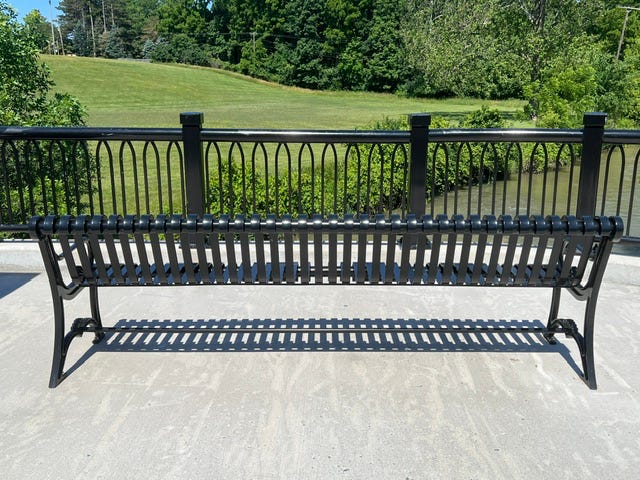
This also explains why I love the flash form so much, flash being a form that relies heavily on what’s not said, thereby engaging the brain to look for patterns and connections. Engaging my brain in the analysis it loves and craves.
The next time you read a story that feels “just right” to your brain—gives you that little satisfactory high—ask yourself why. Why do I like this story so much?
And then keep asking yourself why.
If you like the story because you like the characters, why? What do you like about the characters? If you like them because they make you laugh, ask yourself why again. And keep drilling down further. Ask how, too. How did the author make this character humorous? What is the effect of the humor? How would this story be different if the character was not humorous?
This is what I talk about when I talk about analysis.
Third, Intuition
When we follow our intuition, we generally feel aligned, i.e., with our values, and at peace with our decisions. Even if something seems counterintuitive, we often know we’ve made the right choice when we listen to our intuition.
As a kid, I remember thinking how nice it would be if I could just put my textbooks under my pillow at night and learn the material by “osmosis” as I slept. (I’m sure many people thought this!)
The funny thing is that honing your intuition really is a kind of osmosis. There’s a reason why writers are advised to read widely, but also to read and analyze (see above section) the kind of stuff they want to write/publish. When you go to write or revise, you may not be consciously thinking about that novel you read five years ago, but your subconscious might be! Especially with automatic writing (freewriting, timed writing, etc.), we’re tapping into areas of our brain that we may not be able to tap into consciously.
Learning to listen to your intuition means, in part, learning to listen to yourself, which is often harder than it sounds.
We are constantly bombarded by noise, by which I mean literal noise as well as the thoughts and opinions of well-meaning others. Learning to listen to yourself often requires quiet. For me, my daily walks/runs are a form of meditation. I’m not always thinking actively about something, but I let thoughts form. I watch leaves moving in the breeze. I look at shadows (if you follow my Substack Notes, you’ve probably seen a lot of my shadow photos). I don’t listen to music or podcasts when I walk or run. I listen to nature and the environment around me. I notice. I notice the ants on the ground, and I notice the things that don’t belong, e.g., shoes hanging from a power line.
And I listen to myself. What am I feeling? What do I want? I’m not generally thinking about anything in particular; I’m just letting what comes, come. Listening.
And in these spaces, ideas do come to me. Insights come to me. Solutions come to me. Both writing- and non-writing-related. Plot points, word choices. How to end a story I’ve been struggling with for weeks. Etc.
For me, writing can be a slow process because of these “contemplations.” When I’m stuck in a story, this is when I know I need to be outside where I can hear myself, unencumbered by inside noises and distractions.
Listening to yourself—getting to know yourself—and actively studying writing (getting into the habit of regularly analyzing what you read) work in tandem.
Our subconscious is amazing. If we consciously process some bit of information, this information may be stored somewhere but is not always readily accessible. But the more we study and analyze writing, the more this information permeates into our writing life. If something feels right, it may be because you’ve sat with it subconsciously and what you’ve studied about writing is telling you that it feels right for a specific craft-based reason that you might not be able to consciously explain.
—
What are some of your own experiences with curiosity, analysis, and intuition in your writing? Leave a comment below!
Immersion Updates
You may recall that my guiding word for the year is immersion, and seeing as we’re nearly at the halfway point of the year (!), I thought I’d share a quick progress report.
I continue to immerse myself in growing my business, and have recently added a newsletter option to my website. Unlike my Substack, which I publish semi-regularly and write about a wide variety of writing-related things, my website newsletter is primarily aimed at keeping you abreast of new JEK Writing Studio offerings and specials. Upon signing up for my mailing list (which you can do on my website), you’ll receive 10 quick tips for success as a creative writer (and a discount code!), and then will only infrequently hear from me. (I hope you’ll sign up!)
I continue to immerse myself in a lengthy process of sorting, which has involved opening and going through boxes and papers I haven’t looked at for years. I’ve gotten rid of several trash bags of stuff so far. It’s been fun to look at old writing notes from my grad school days as well as assessments I created as a teacher—and to see how much I’ve changed (as well as the ways I haven’t!).
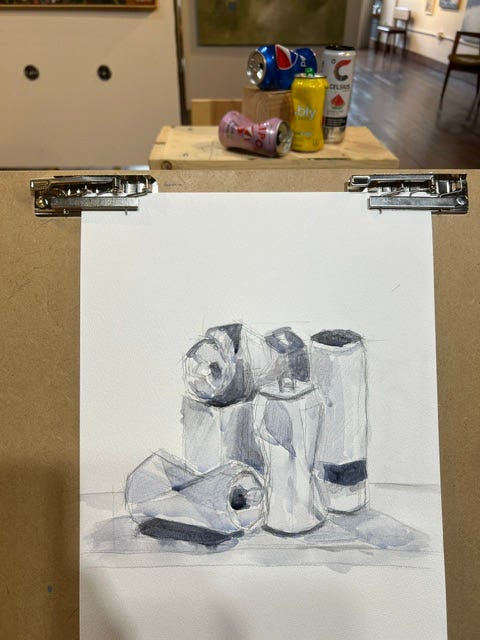
I continue to immerse myself in learning to draw, and, as noted in my previous post, I’ve been practicing with watercolor. I am also signed up for my city’s plein air festival in August, which means that for the first time ever, my work will be judged and viewed by a broad public audience. Not only that, but I will be creating in public, outside (the definition of plein air). It’s a scary prospect, but that’s what immersion is about for me: getting out of my comfort zone, practicing, and pushing myself.
I continue to immerse myself in running, with an eye on two possible runs (a 5K and a 10K) in July, as I work toward my October half-marathon goal. I will decide over the next couple of weeks whether I sign up for one or both races. Today I ran 6.5 miles, and it felt good.
Latest Publication
June 13 was National Flash Fiction Day (UK), and I was happy to be in the FlashFlood once again with my story “Just Another Life Experience,” another story to come out of my October 2025 prompt challenge.
Need Prompts? Coming in July: An Ekphrastic Prompt Extravaganza—for Paid Subscribers
In July (starting July 6), I will be offering paid subscribers a month’s worth of ekphrastic prompts.
Select prompts will be available to free subscribers as well. Stay tuned!
New to JEK Writes? I’m thrilled you’re here! Feel free to scroll through my previous posts on the JEK Writes homepage.
Want to support JEK Writes, but not ready to become a paid subscriber? You can buy me a coffee!
I appreciate your reflections on walking as meditation. I do the same. I think of it as my "free-thinking" time, just letting things flow and tuning in to my surroundings. It's an important, enriching part of my day!
***Math equations with the clock***
I do them with the previous night's winning lottery numbers. I hope someday it will lead me to play winning numbers myself. LOL