
A Rite of Passage
Five Insights from Writing a Story Draft a Day for Thirty Days

I’m happy to report that as of last Thursday, I successfully completed my self-imposed challenge of writing a flash fiction draft a day for the month of April. Thirty days, thirty drafts! ✅
Though I’ve done month-long challenges like this before, I experience it differently each time. What “wacky” ideas will I come up with this time? I’m often pleasantly surprised! Because writing thirty drafts is not just writing thirty drafts; it’s an exercise in a broader vision for myself and my practice of the craft of writing.
If you’ve been following along with my posts, you’ll have seen the ekphrastic prompts I created and gave myself in April—because in the midst of this thirty-day challenge, I discovered that I love ekphrastic writing prompts!
I’ve included two more ekphrastic prompts below, which I used for my last three April drafts.
First things first, though.
Why Write a Draft a Day for a Month?
“The gull sees farthest who flies highest.”1
As I see it, there are many reasons to embark on this kind of writing challenge, not the least of which is that it’s simply good practice.
But I also embarked upon this challenge at this particular time because my writing was feeling stale. Any time your writing starts to feel stuck, the number one thing I recommend is doing something different to get it unstuck, whether it be taking a workshop/class, trying a different genre, or some other challenge.
To keep your writing from stagnating, you need to keep challenging yourself.
The goal is to keep improving, to keep learning. To fly higher, see further.
1. When expectation is removed, anything can happen.
Something that I appreciate about no-stakes drafts—which all of these drafts were—is that they allow for a higher level of experimentation. You might be thinking, “But isn’t every draft a no-stakes draft?” Maybe, yes. But when we sit down to write with a specific idea or goal in mind, our brains don’t always process what we’re writing as “no-stakes.” More often, we start writing with a particular idea in mind—this is especially true if you’re a “plotter”—and expect the draft to “go somewhere,” turn into “something.” We might spend hours working on a draft, committing to it.
Writing a draft a day removes that pressure. First of all, I write these no-stakes drafts quickly, usually spending an average of 15 minutes on each one. I start with a prompt and maybe just a little seed of an idea. The stories are rough, some rougher than others. When I go back to them later, I can typically find something redeeming in each draft, but some of them will indefinitely remain first drafts. And that’s okay! Many of those first drafts spark new ideas. And that’s precisely the point. It doesn’t matter if they turn into publishable stories or not.
Because my mindset is that this is simply practice, there’s a level of expectation that is removed. And when expectation is removed, anything can happen.
2. Practice makes better.
Like most things that one does regularly, writing a draft a day tends to get easier over time. I dislike the old adage that “practice makes perfect” because perfect in a subjective field like creative writing doesn’t exist. (And as a “recovering perfectionist,” I find striving for perfect to be problematic.) So I like to reframe it as “practice makes better.”
Because it does.
When I taught ESL and Rhetoric classes, part of the university’s curriculum required that students be able to write in-class timed essays to prompts; their ability to successfully perform this task often determined whether they passed the class or not, so it was very high-stakes. Therefore, at the start of each class session, I’d have my students do low-stakes (ungraded) freewrites. (I did look at them and give feedback to the students, so they weren’t exactly no-stakes, but because the freewrites weren’t graded, the stakes were about as low as they could be.) I considered them a kind of “warm-up” to get the students in the right mindset for class—but the freewrites also served as practice. At the end of one semester, one of my ESL Academic Writing students told me that she had initially hated the 10-minute freewrites at the beginning of each class because she disliked writing in general, but by the end of the semester, she had started to enjoy them; in fact, she ended up signing up for a creative writing class the following semester! What she disliked about writing was the stakes; when you remove those—when you allow simply for practice—you not only improve, but the activity often becomes more enjoyable as well.
The same is true for virtually any activity—practice makes better, and it allows you to push yourself further. I see it with my running, as I’m preparing for a 10K at the end of May. The idea of training is, of course, to improve, but the more I practice, the more I’m excited to see what else I can do. (And, incidentally, this idea of “practice makes better” is precisely why I chose immersion as my guiding word for 2026.)
3. Don’t limit yourself. Creativity begets creativity, and the more creativity you embody, the more options you have.
As I noted earlier, one of the reasons why I issued myself this thirty-day challenge was because my writing was feeling stalled, so it’s probably not surprising that my first few drafts of the month felt a little uninspired. But because these were no-stakes drafts, it didn’t matter, which, perhaps somewhat paradoxically, gave me the freedom to try ideas that I might not have typically tried—simply because that’s how creativity works. The more you lean in to it—use it—the more you have. And, indeed, that spark of creativity reemerged pretty quickly, and I started to gain momentum, so much so that, instead of being tired at the end of the month (as I often am when I do these month-long challenges), I was rarin’ to keep going! Exactly as intended. This is one reason why I don’t believe in writer’s block. Because giving in to a creative block, i.e., not writing because you don’t feel inspired, just serves to prolong the block.
I think of this when it comes to revision, too. When I’m stuck in a story, it’s usually because I’ve limited myself in some way, e.g., not wanting to change a character’s motivation or refusing to remove some element that’s not working well. As soon as I let go of these self-imposed limitations, though, the story takes on new life, and I start to see all sorts of new opportunities for not just that story, but others, too! Creativity begets creativity.
4. Showing up is [more than] half the battle.
Over the winter, I was walking almost every day—even on the coldest days. Most days it would have been easy to tell myself that it was too cold, too snowy, etc., and rationalize myself out of walking. What I found, though, was that the anticipation—the thinking about the cold, for example—was worse than the actual activity. Once I pushed myself out the door and started walking, I felt great, and I was always glad that I had done it.
Writing a draft a day is similar. It can be easy to psych yourself out or make an excuse not to do it. I’ll add the caveat that there are certainly valid reasons for not pushing yourself. My point, though, is that too often, we make excuses for ourselves—to ourselves. How often have you heard (or said), “I don’t have time"? Sometimes it’s a legitimate excuse, but other times it’s just an excuse.
Sometimes the hardest thing is just getting started—getting yourself out the door for a winter walk.
On days when I didn’t really feel like writing my draft, I told myself, “Well, you can certainly take five minutes to sit and write something.” Just sit for five minutes, Jessica! And all of the sudden, the words would start flowing, and before I knew it, there I was with a shiny new draft!
The beauty of committing to writing a draft a day is that it creates a kind of accountability. More often than not, the times when I’ve simply “shown up” are times when something exciting has happened, e.g., an exciting first draft or a new running PR.
Are you showing up for your writing?
5. Whatever you do, challenge yourself.
You, of course, don’t have to write a draft a day for thirty days to challenge yourself as a writer; there are many other possibilities!
The bottom line, though, is that if you don’t challenge yourself in some way—break the status quo of your writing process/routine—you won’t be able to fly as high or see as far.
Two More Ekphrastic Prompts
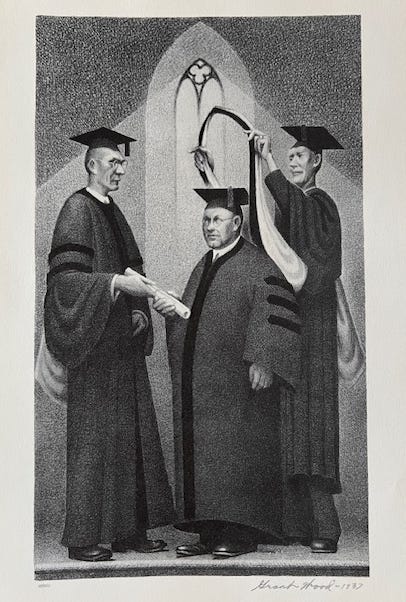
Prompt 1: A Rite of Passage
The print below is Grant Wood’s Honorary Degree. The blurb accompanying this work in A Treasury of American Prints (1939), edited by Thomas Craven, states (in part): “For here, in what might at first glance look like a surgical operation in a cathedral, Grant Wood has caricatured a disagreeable American vice: glorification of the second-rate by mumbo jumbo. The squat, paunchy, mindless, and self-satisfied center of academic attention in this mysterious ceremony has just presented the old alma mater with a new, if slightly reduced, replica of the Yale Bowl. In return for this support of enlightenment and culture, he is becoming an honorary doctor of law…. Is it not the very essence of petty importance?”
There’s a heavy emphasis on the sham of this ceremony (similar to this earlier ekphrastic prompt). And it brought to mind for me other silly ceremonies, traditions, and rites of passage that some hold dear.
Prompt: Think of a ceremony, rite of passage, or celebration. Consider things like bridal showers, kindergarten graduations, and other often inane celebrations or ceremonies. Write a story satirizing such a celebration. Feel free to create your own, e.g., a party for a kid’s first haircut (or maybe that’s actually a thing??), and play up the ridiculousness of it. Or go completely surreal.
I got two stories out of this prompt—and could certainly do more!
Prompt 2: “Noxious Institutions”
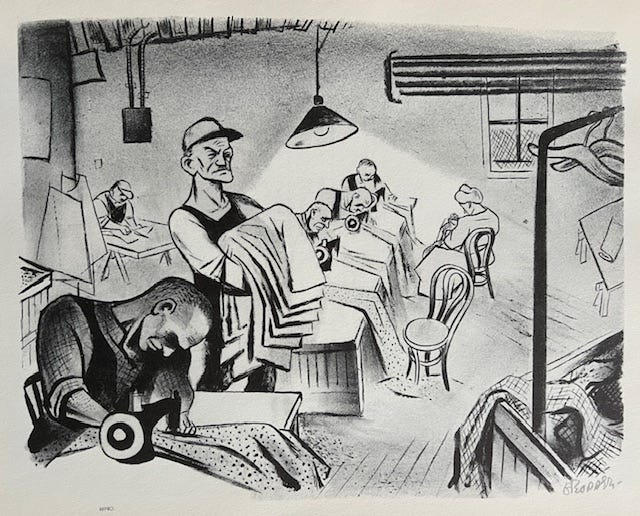
The below print is Sweatshop (~1934) by William Gropper. As described in A Treasury of American Prints, “Sweatshop is a hard-hitting slam at one of the most noxious institutions in industrial life…. There is merit in Gropper’s statement that ‘I draw pictures of this world of ours, and they’re not all pretty pictures.’”
Prompt: Write a story about a “noxious institution,” especially one in which the people exposed to it are hardened in some way, their bodies aching and their creativity stifled.
Unsurprisingly, the story I came up with from this prompt was very dystopian; I focused on the stifled creativity aspect of the prompt.
My Latest Publication
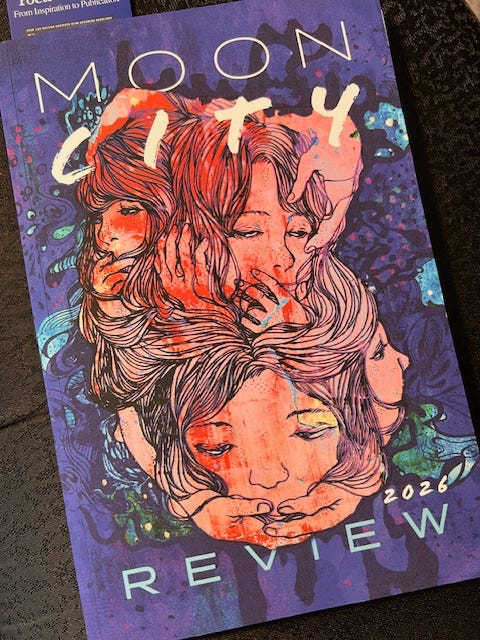
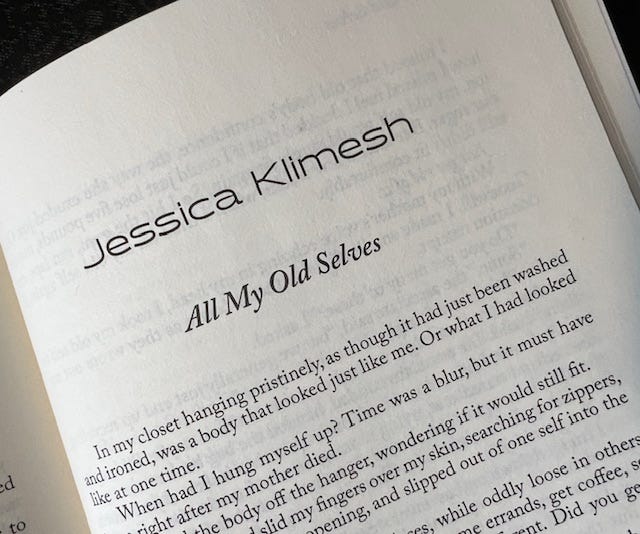
I’m thrilled to have my story “All My Old Selves” in the gorgeous print journal Moon City Review. My first time being published in this journal!
Hot Flash Literary Submissions Are Open!
The online flash journal that Tina Carlson and I co-edit is now open for submissions for Issue 4! Theme: Instant Karma.
Submissions are open to women-identifying writers; we accept flash and flash-like prose poetry up to 500 words. Find complete submission guidelines here.
Be sure to read previous issues to get an idea of what we publish!
Bach, Richard. Jonathan Livingston Seagull: The Complete Edition. Scribner, 1970, 2014.
The "shitty first" draft is always hardest for me. It makes so much sense that regularly breaking the proverbial seal makes it easier. Thanks, as always, for sharing good advice forged in the furnace of experience! And thanks for more of these evocative ekphrastic prompts!
For a number of years in November, when others were doing Novels for NaNoWrMo, I would select 30 of my own photos and write a draft to one each day. It forced me to just let go and write whatever came out and not worry about making improvements as I wrote the draft, like I always tend to do. Later, after revision so many of those pieces were published. I haven’t done the piece a day thing for a few years, but I do remember (quite often) to just let that first draft flow. Those pieces often end up being some of my best. 😊