
Resisting Writer's Block
The Benefits of Constraints When You're Stuck

Note: Some of this post (particularly the second half) is recycled from May 2023’s “Honing Creativity: Lessons from Magnetic Poetry.”
What Is Writer’s Block (Besides a Fancy Label)?
In 2019, I wrote a blog post in which I stated that writer’s block is basically just an excuse, a fancy name for other distractions that keep us from writing. Writer’s block. It sounds important, professional. Official.
I want to acknowledge that sometimes we may find it hard to write due to anxiety or other setbacks unrelated to writing tasks, which can create an inability to focus. I wouldn’t classify that as writer’s block.
Often, writer’s block comes from a fixation on perfection.
But maybe even more often, writer’s block is actually a creative block. Creativity is a muscle that you can stretch, strengthen, and use in ever-evolving ways. It exists on a spectrum and can vacillate. But we can train ourselves to be more creative by regularly exercising our creativity, much like we might train at the gym.
Breaking out of a creative block is really about immersing yourself in creativity, whether that be going to a play or art museum, taking an art class, trying a new recipe, writing or reading outside of your comfort zone, or any other of the literally limitless possibilities.
Immersion.
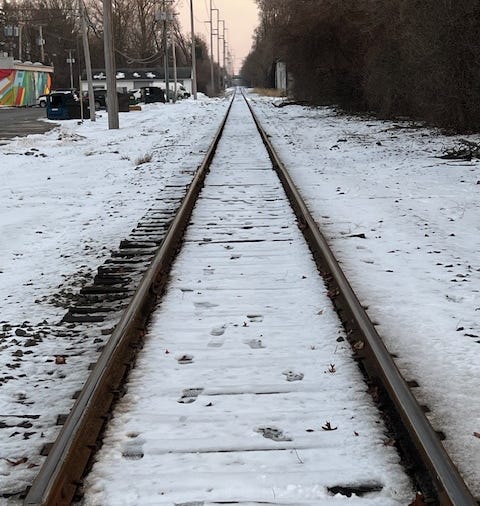
If you read my previous post, you may recall that for 2026, I’ve chosen the word immersion as my guiding word, and at twenty-one days in, I’ve found that it really is the perfect word for me this year. Among other things, I’ve been immersing myself in nature, taking long walks each day; yesterday I walked nearly six miles. And it’s frigid where I live (yesterday was single-digit temps), yet immersed in the cold weather on a walk, I suddenly don’t mind it. The icy cheeks, the runny nose, the vigilance I must maintain as I walk over unshoveled sidewalks and icy patches. Sometimes I stop just to take in the changing landscape—and, yes, in this weather, it changes daily. I often stop at the railroad tracks.
Immersion vs. Settling
Creatively, I’ve spent most of January immersed in revising two stories. One I just submitted today; the other is causing me some problems. Creative problems. Not writer’s block.
One thing I realized as I’ve been working on the “problematic” story (a story I originally wrote in 2018) is that immersion, to me, means (in part, at least) not settling. In fact, my friend Lucinda writes about this, too, in her Substack post, “What Are You Done Settling For?”
Perhaps influenced by the word immersion, I’ve been feeling a surge of “striving” energy lately. It’s a powerful feeling of wanting to stretch myself, push myself, do more, go all in. Of wondering: How far can I go?
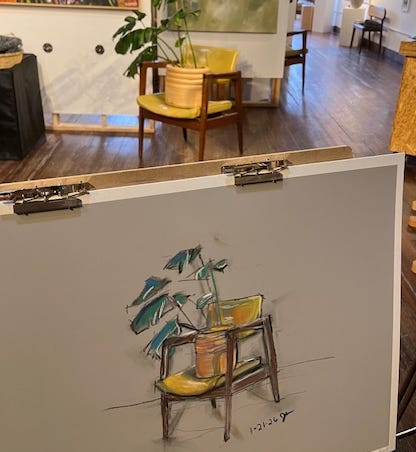
When I submit my work, I want it to be the best it can be [at that point in time]. I don’t want to settle for “good enough.” If it doesn’t fully excite me, that’s a warning to myself that I might be settling.
I’ve spent the last several days wondering what to do with this “problem” story. I want it to feel fresh. To sparkle and shine.
During my walk yesterday, I decided that one of the problems I’m having with it is that I’m staying too close to the original draft (despite having cut a whopping 2500 words!). The original story was written eight years ago (and was obviously not written as flash), and though it’s fiction, there are elements of truth in it; and so much has changed in eight years that my truth from back then is radically different than my truth today. Which makes the story feel partly like a contrived truth.
I’ve not only changed as a person since then, but I’ve changed as a writer. I could keep working on the story as it is, staying true to the original story, but as I was walking, my inner voice called me out on it: you’re settling. You’re not immersing yourself in it.
The voice told me clear as day: Don’t settle!
This idea of immersing and not settling prompted the topic for my latest YouTube video as well.
I don’t want to be someone who goes to the gym just to get it over with; I want to be present, fully engaged.
I don’t want to be someone who goes for a walk because I have to. I’ve learned to enjoy my cold winter walks. They make me feel alive.
But, especially, I don’t want to be someone who writes a story just to get it done—just to have written something. I want to enjoy the process.
It’s not always easy. For all of these things, I do have to push myself, motivate myself. (And sometimes I procrastinate by writing Substack posts.)
Creative writing should be fun, not something you’re just trying to get through. (In fact, I think that’s true about many of the things we do in life. And this is the main idea that my word immersion keeps reminding me of.)
And as a writing coach, this is also one reason that I love working with writers who value the writing process and aren’t just trying to “get something done” for the sake of getting it done.
But what happens when we’re stuck? When we have a creative problem to solve?
For the current story I’m working on, I know that I need to approach the revision process differently than I have been—I need to find a new way into the story—which often means imposing constraints on myself as I write in order to find new inspiration, new ideas.
I Want to Write Like That!
I read a lot of flash and microfiction—stories that can be read in just a few minutes—but I can’t always digest the stories that quickly. I am drawn to short prose that invites me to read a piece over and over, often allowing for multiple—or deepening—interpretations, that makes me think: I want to write like that!
Where once I may have felt envy at another writer’s talent and imagination, I now glean inspiration from such stories; they remind me of the endless flexibility of fiction and urge me to boost my own creativity so I can come up with something just as clever, profound, or inventive.
A recent [as of May 2023] favorite story of mine is “A Contented Sun Rises” by Joe Artz. I love this piece for many reasons: the originality, the specific details, and the way I am immersed immediately into the strange little world Joe has created. I can visualize it, feel it. I want to write like that!
I will admit that I’m somewhat biased because Joe is a friend of mine, but the story was a finalist in Cleaver’s 2022 flash fiction contest, so I’m clearly not alone in my assessment. And having previously been in a writing group with Joe, I know that this story is not an outlier; Joe has an uncanny knack for regularly creating intriguing literary worlds.
When I read a story that gets my brain’s synapses firing with excitement, I’m compelled to write. Story ideas come flooding in.
In short, creativity begets more creativity.
I’ve studied the subject of creativity quite a bit. I know that creativity can be developed, honed, and improved upon over time. The question one may ask is how?
The answer will be different for everybody, of course, but I’ve found that there’s actually a lot to learn—about both creativity and writing—from constraints.
And I’ve found that the constraints of magnetic poetry are a good lens to peer through.
Creative Lessons from Magnetic Poetry
In high school (and into college), my friends and I frequented Borders Books (remember them?). Borders had everything: a coffee shop, live music on the weekends, and, of course, books!
They also had magnetic poetry, which I was a bit obsessed with.
Magnetic poetry might not seem like such a novelty now, but circa 1994, it was (at least for me). (I read recently that magnetic poetry first appeared in 1993, but I wasn’t able to verify that.) At Borders, they had the poetry out so that you could “play” with it, and there was also a book of poems written with magnetic poetry that you could look through. As someone who fancied herself a budding writer, I wanted my own set. But the sets were kind of pricey, particularly for a high school/college kid with meager income/savings.
A few years later (1998), though, a poet/musician friend and I bought a set of magnetic poetry together—to share. We divided the set up so that we each had an even number of words, and then we’d sit for hours at this coffeehouse called Picasso’s, drinking coffee and/or tea and writing (both with and without the aid of magnetic poetry).
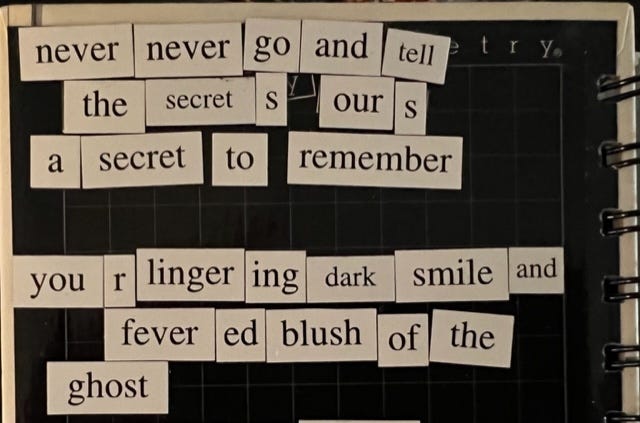
More than twenty-five years later and I still have that magnetic poetry set (and I think the friend eventually gave me his share, too). I’ve since bought a couple of other set variations as well. My refrigerator is currently covered in words.
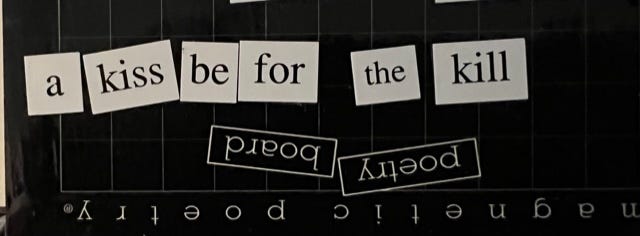
Much as I do when I read a compelling story, I feel a surge of excitement when I rearrange the word magnets on my refrigerator to create something strange, new, different. Creative.
Lesson 1. Constraints Can Heighten Creativity.
With its limited word options, magnetic poetry offered me one of my earliest creative writing constraints.
Research heavily supports the idea of constraints aiding creativity. In a Harvard Business Review article called “Why Constraints Are Good for Innovation,” the authors write, “Constraints can foster innovation when they represent a motivating challenge and focus efforts on a more narrowly defined way forward.” While the article is talking about business-related innovation, the tenets can apply to writing as well (and not just creative writing).
Another article, “How Constraints Force Your Brain to Be More Creative,” discusses how constraints allow you alternate perspectives. Doing something because it’s familiar or because that’s the way you’ve always done it is akin to following the path of least resistance, which research shows can impede creativity. With my own writing, the more I rejected “convention,” the more comfortable I felt in my writing voice. I began to trust my creative instincts. And from there, my writing really began to evolve; I felt freer and more imaginative.
Yet another article further posits that barriers can “lead to breakthroughs.” Often when I revisit a story that I’ve put away because it’s just not working, I implement barriers of some sort in an effort to revive it. This is what I’m currently doing with my problematic story. My first—and overarching—constraint is the fact that I want it to be flash (general definition being fewer than 1000 words). Radical revision enthralls me, partly because it’s basically me approaching a problem that needs to be solved creatively. I am motivated by this kind of challenge, excited by it! Ready to be immersed in it!
Writers, of course, have long been experimenting with constraints. Perhaps you’ve heard of Gadsby, the 1939 novel by Ernest Vincent Wright that does not include any words using the letter e.
And in his bestselling book (which I highly recommend) A Swim in a Pond in the Rain: In Which Four Russians Give a Master Class on Writing, Reading, and Life, George Saunders has an exercise in which he challenges readers to write a (precisely) 200-word story using only 50 different words. Saunders writes how this exercise—which he uses with his students—“shuts down that way of thinking [how we should write] by keeping [the mind] busy with the practicalities of the exercise, which leaves the rest of the mind asking, ‘Well, what else have we got?’ That is: ‘What other writers might be in here?’” (p. 402)
In many ways, being confined to 50 words isn’t all that different than using magnetic poetry.

Lesson 2. Unique Word Combinations Abound.
At its core, creative writing is about expression—about creative expression. But one of the challenges is finding fresh and original ways to express one’s thoughts and ideas. This is one of the reasons that beginning writers are often told to avoid cliches. (“Avoid cliches” is actually misleading advice, but that’s a whole different rabbit hole.)
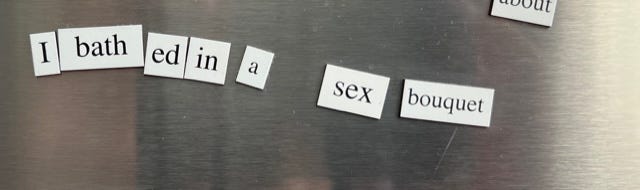
Word Pairing Exercise
Try this. Make a list of adjectives.
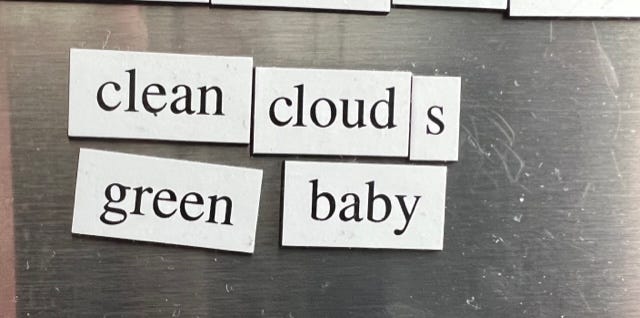
e.g., red, lovely, startling, crazy, damp, stingy, brazen, wicked, melancholy
Now make a list of nouns.
e.g., truck, doll, dog, locomotive, cape, box, summer, breeze, giggle
Connect one of your adjectives to a noun in an unexpected, original pairing.
e.g., a startling summer, a stingy breeze
Or add to your lists and mix and match.
e.g., a startling summer breeze, a stingy summer breeze, a red giggle, a melancholy giggle
It doesn’t matter if the phrase is logical or not. The idea is to spark your imagination, get the creative juices flowing.
Lesson 3. An Extensive Vocabulary Is Not Essential.
Having a robust vocabulary can certainly be beneficial to a writer, but it is not a requirement for creating profound and innovative work. The words in a magnetic poetry set aren’t generally difficult words; they certainly won’t help you prepare for the GRE.
Much of the creative work I read and enjoy doesn’t use fancy obscure words. It’s more about how the words work together, how they create tone or a distinct voice. Being cognizant about word choice and being curious about language are key skills for a writer, and this is something that magnetic poetry can highlight.
My tenth-grade English teacher bombarded us with a lot of rules for our (academic) writing. I recall that for at least one essay we had to label each sentence in the essay as either simple, complex, compound, or compound-complex. The exercise had several goals. It helped ensure, first, that we didn’t have fragments or run-on sentences, but it was also meant to draw our attention to sentence structure variety. That is to say, the teacher would require a certain number of each type of sentence, e.g., at least one compound-complex sentence.
For almost every essay, my teacher also had us do a le mot juste exercise. We only had to show our work for one word, but I’m sure it was her hope that we paid close attention to word choice throughout. For one particular word in the essay, we had to show that we had looked up several word choices and then write a short explanation as to why we picked the word we did—why it was the most appropriate word for the context. Le mot juste. (Additionally, we were never allowed to use the words people or thing(s) in our essays.) Her rules forced us to write more precisely, more specifically. Perhaps I learned some new vocabulary in the process, too, but that wasn’t necessarily the point of the exercise; the exercise was more focused on connotation and appropriateness.
I have a collection of poems that were written (by various writers) using magnetic poetry. Some of the poems are funny. Some are deep. Most all of them are interesting. Even with every poet in that book using the same selection of words, the voices and styles are unique, distinct. Constraints, in other words, do not limit your voice or style.
Although I’ve pared what was once a 3500-word story down to 940 words, I’m still aiming for shorter—I’m aiming for 800 words or fewer. Why? Because I need the creative boost that comes from constraint.
I may need to change the point of view or the verb tense of the story. I may need to add an element to the story that constrains me further.
At any rate, I’m immersing myself in the challenge and boosting my creativity—exercising it—at the same time.
We’ll see what happens. Wish me luck! ;-)
Until next time, happy writing, friends!
I miss my magnetic poetry set (*scratches head and wonders where, along the way, it wandered off to*)! And I love the way that walks can loosen creative blocks and the way that constraints sometimes bring freedom.
First - would love a long walk on a cold day - so if you're looking for company sometime, let me know. And, If immersion is your word - don't settle is mine. And I think I prefer immersion - if I find something I can immerse myself in, I won't be settling!